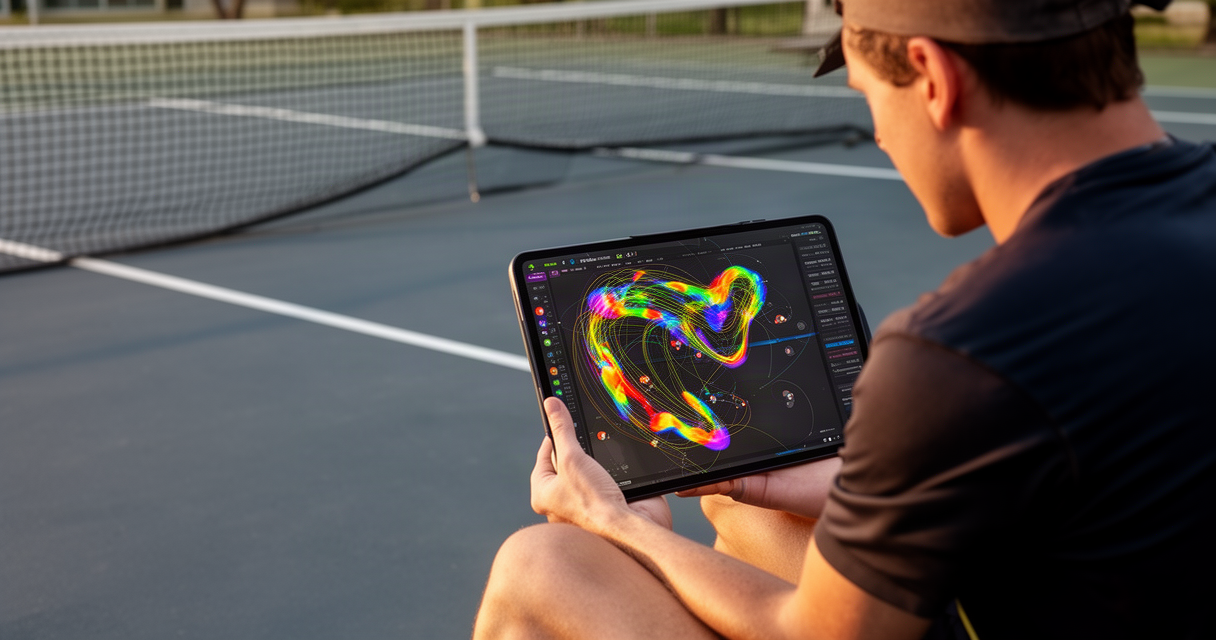
The demo clip is the same every time: a glowing shot trail arcs across the court, a heat map fills in behind it, and a dashboard spits out a skill score that looks like it came from a lab. It is a compelling pitch. The open question is whether that trail actually makes a player better, or whether it just shows the same loss they already felt in the moment, now rendered in neon.
For competitive players training without a coach, that distinction matters. Video review time is limited, subscription budgets are not infinite, and a bad rating or a misread stat can send a training block in the wrong direction for weeks.
The short answer: PB Vision is worth the subscription for competitive, self-coached players (roughly 3.5 to 5.0) who will actually open the shot explorer and treat the data as directional, not gospel. It is not worth it for casual or social players who won’t act on the numbers. The skill rating runs hot against DUPR, some shot misclassifications can’t be corrected, and processing delays are a real, recurring complaint — not an edge case.
The rest of this breaks down what the tool actually measures, where it earns its price, where it falls short, and how it stacks up against the alternatives.
What PB Vision Actually Does (and Doesn’t)
PB Vision is a computer-vision platform built specifically for pickleball. A player uploads match video — typically shot from a phone or camera mounted courtside — and the software processes it after the fact.
The output includes automatic shot classification (dinks, drives, drops, serves, third shots), court coverage maps showing where each player spends time, auto-generated highlight clips, and pattern data on shot selection and shot quality by type.
What it does not do is call lines in real time or officiate a match as it happens. This is a post-match, upload-based analysis tool, not a live line-calling system like the sensor-based setups now used in some professional and collegiate events. Confusing the two leads to disappointed expectations fast.
It is also worth being precise about the category PB Vision sits in. It is a data tool. It tells a player what happened during a match — shot counts, coverage percentages, rally patterns. It does not tell them why a shot broke down mechanically, and it does not tell them what drill fixes it. That interpretation step still requires a human, whether that’s the player themselves, a training partner, or a coach.
Where PB Vision Actually Earns Its Worth
The strongest case for PB Vision is pattern visibility a player cannot get from inside their own point. Standing at the baseline mid-rally, it is nearly impossible to accurately track serve depth across a full match, kitchen-line arrival percentage, or shot quality broken out by dink versus drive versus drop. PB Vision logs all of it automatically and lets a player pull up side-by-side comparisons across multiple matches.
That’s a genuinely different vantage point than self-review. A player watching their own film sees isolated moments — a missed third shot, a good put-away. PB Vision aggregates hundreds of shots into rates and trends, which is closer to what a coach does when reviewing a season of tape rather than one match.
This is the same category shift that shows up in other sports once AI-assisted video review becomes available to athletes training alone — the value isn’t in replacing coaching entirely, it’s in giving a self-coached athlete data density they couldn’t generate by hand. The same logic applies to AI form-check apps for training without a coach: the tool surfaces patterns, the athlete still has to act on them.
The best evidence for this on the pickleball side is anecdotal but specific. In a discussion on r/Pickleball, a player reported climbing from a self-assessed 4.0 to a 4.4 using PB Vision’s shot data to identify weaknesses in their game. That improvement is self-reported and not independently verified — no controlled study backs it — and the same player noted a real limitation in the same breath: “It will definitely miss shots and incorrectly classify a few shots a game… I went from a 4.0 to 4.4 with help from it.” The gain is plausible and the caveat is worth taking as seriously as the headline number.
Where It’s Just Expensive Scorekeeping
The failure mode that shows up most often in community feedback is not a missing feature — it’s an uncorrectable one. When PB Vision misclassifies a shot, there is frequently no way to fix it inside the app.
A player on r/Pickleball described a specific version of this: “I pick up the ball and return it to the other team, and the app records it as a failed serve. There’s no way to edit out that shot, so all the data is skewed.” That’s not a cosmetic bug. It permanently distorts serve percentage and shot-quality stats for that session, and there’s no manual override to clean it up.
An iOS App Store review put the same problem more bluntly: “When the AI gets something wrong, there is not a manual way to fix it.” Wrong-player crediting shows up in the same category of complaint — a shot logged to the wrong side of the court, with no correction path.
Processing time is the second recurring complaint. Community reports put turnaround anywhere from 3 to 24 hours after upload, and one Google Play review cited processing “now at 26 hours for one of my videos.” Video length caps have also shifted over time — recent community reports put the limit around 20 minutes per upload on standard tiers, though this is a setting vendors change without much notice, so it’s worth confirming current limits directly on pb.vision before planning a full-match upload.
The skill rating itself is the third weak point, and it deserves its own section below — but as a standalone complaint, multiple players in r/Pickleball describe the score running high and inconsistent, in ways that undercut its usefulness as a standalone benchmark.
Is PB Vision Accurate? What the Community Reports
There is no independently published accuracy benchmark for PB Vision’s shot classification or skill rating. Any accuracy percentage a reader encounters in marketing material is vendor-sourced, not third-party verified, and should be read that way.
What does exist is a consistent pattern in community reporting: PB Vision is reliable on shots that are obviously out — a ball that lands two feet past the baseline gets classified correctly nearly every time — but weak on anything close to the line. A player on r/Pickleball summarized it directly: “PBvision is terrible at line calling… anything near the line it has no clue.”
This isn’t unique to PB Vision. Edge-case accuracy near boundary lines is a known limitation across AI motion-analysis tools generally, not a PB Vision-specific failure. The same near-line, close-call weakness shows up in AI motion-analysis tools in running, where gait-tracking systems perform well on clean, isolated form breaks and worse on marginal, borderline cases that require more context than a single camera angle provides.
SwingVision, the closest direct comparison, processes video closer to real time and has a longer track record — but that track record is in tennis, not pickleball. SwingVision was built for tennis first and added pickleball support in late 2023, meaning the pickleball-specific model has had a fraction of the training data and iteration time that the tennis product has had. Maturity gaps like this are worth weighing the same way a reader would weigh AI accuracy vs a gold-standard baseline in any other fitness-tech category: a tool can be directionally useful without being precise enough to trust on the margins.
The practical takeaway is not that PB Vision is broken. It’s that its edge-case accuracy — line calls, ball-retrieval-as-serve errors, close player crediting — is a known, community-documented weak point, and treating any single close-call classification as ground truth is a mistake.
PB Vision vs DUPR: Two Different Numbers, Not Competitors
DUPR and PB Vision measure different things, and the two ratings should not be read as competing answers to the same question.
DUPR is results-based and predictive. It calculates a rating from match outcomes and opponent strength, and its purpose is forecasting — telling event organizers roughly how a player will perform against a given field.
PB Vision’s skill score is performance-based and descriptive. It’s generated from computer-vision analysis of in-game behavior — shot selection, coverage, execution rate — not from who won. It describes how a player played, not whether they won.
As of this writing, PB Vision and DUPR have an official partnership, though the specifics of data-sharing and rating integration are worth verifying directly on both platforms since partnership terms in this space change often. What community reports consistently flag is a gap between the two numbers: PB Vision’s rating tends to run 0.3 to 0.7 or more above a player’s DUPR rating, and the gap is inconsistent from player to player rather than a fixed offset.
Part of that gap is rating inflation on the PB Vision side specifically. Players on r/Pickleball have noted that “almost everyone gets rated 3+ by pb vision,” and at least one thread pointed out a case where a clearly weaker player on a given court received a higher PB Vision score than a clearly stronger one. That’s a rating-calibration problem, not just a philosophical difference between the two systems.
The practical implication: a player should not cancel a DUPR account because PB Vision produces a flattering number. DUPR still gates tournament brackets and league play. PB Vision answers “how did I play,” DUPR answers “did I win, and against whom” — both are useful, neither replaces the other.
The Real Cost: PB Vision vs SwingVision vs PickleWatch vs DinkAI vs a Human Coach
Pricing across this category shifts often enough that any number here should be treated as approximate and verified directly on the vendor’s site before buying.
PB Vision’s reported pricing, as of this writing, runs about $19.99/month for a Starter tier and about $49.99/month for Premium, with additional minute-packs available separately (roughly $9.99 for 60 minutes, $39.99 for 300 minutes, $99.99 for 1,200 minutes). Some users also reference legacy annual plans around $99/year or $396/year, suggesting pricing has moved multiple times. Verify current tiers on pb.vision before subscribing.
SwingVision’s reported pricing sits around $179.99/year or about $14.99/month, with an hours-of-recording cap on the monthly tier. Confirm current numbers on swing.vision.
PickleWatch is a different category entirely — real-time swing feedback delivered through an Apple Watch rather than post-match video analysis. It’s reported as free with an optional premium tier, but no reliable public price point could be confirmed; verify current pricing directly with the vendor.
DinkAI is also a different tool than it might first appear — phone-camera technique and drill coaching rather than match analytics. Reported pricing is around $9.99/month for premium features, worth confirming before subscribing.
A human coach, for comparison, runs roughly $50 to $150 per hour depending on region and credentials, with most competitive players paying somewhere in the $70 to $100/hour range.
| Tool | What it is | Reported price (hedged) | Best for |
|---|---|---|---|
| PB Vision | Post-match CV analytics, shot classification, coverage maps | About $20–50/month + minute-packs; verify on pb.vision | Self-coached players who want data density from every match |
| SwingVision | Recording, cloud storage, highlight generation (tennis-first, pickleball added 2023) | About $15/month or $180/year; verify on swing.vision | Players who mainly want match footage saved and clipped |
| PickleWatch | Real-time Apple Watch swing feedback | Free / premium tier, price unconfirmed | In-session feedback without a camera setup |
| DinkAI | Phone-camera technique and drill coaching | About $10/month; verify | Technique drilling outside of match play |
| Human coach | 1:1 instruction and live correction | About $50–150/hour, avg. $70–100 | Real-time correction and accountability |
The framing that matters most: PB Vision is cheap relative to a season of private coaching, but it answers a fundamentally different question. Coaching corrects mechanics in real time. PB Vision reports on patterns after the fact. A player on r/Pickleball made a similar point comparing PB Vision to SwingVision specifically: “Swingvision is a recording solution, a cloud storage solution… For any analysis, use PB Vision.” The same logic applies one level up — PB Vision is an analysis tool, not a coaching replacement.
Can PB Vision Replace a Coach?
No. This isn’t a hedge — the evidence points one direction consistently.
Every credible account of real improvement using PB Vision, including the 4.0-to-4.4 self-report cited earlier, pairs the software with something else: a coach, a stronger practice partner, or a structured drilling plan built around what the data surfaced. The data identifies the pattern. It does not fix the mechanic.
The sharpest critique of the tool on this exact point comes from a thread on r/Pickleball: the stats PB Vision collects “represent what can be easily/intuitively collected and reported vs what drives success/failure on a pickleball court.” That’s a real limitation, not a nitpick. Coverage percentage and shot-type counts are easy for computer vision to log. Footwork timing, paddle prep, and decision-making under pressure — the things that actually separate a 4.0 from a 4.5 — are much harder to extract from video without a trained eye interpreting it.
There’s a durability angle worth a brief mention here too. Pickleball’s stop-start movement pattern and repetitive shoulder and wrist loading put competitive players at real injury risk over a long season, and no video-analytics tool addresses that. Structured prehab for racquet-sport durability is a separate, worthwhile investment alongside any data tool — PB Vision has nothing to say about joint load management.
Is PB Vision Worth It? The Verdict, Segmented
Worth it: competitive, self-coached players in the 3.5 to 5.0 range who record matches regularly, who will actually open the shot explorer and dig into the coverage maps rather than glance at the headline score, and who treat the skill rating as directional rather than definitive.
Not worth it: casual or social players. If the plan is to record a match, glance at the rating once, and never open the app again, the subscription is wasted money regardless of how good the underlying tech is.
Maybe: players who already work with a coach. In that case, PB Vision’s real value shifts — it becomes a way to hand a coach objective footage and pattern data instead of a vague description of “I kept missing my third shot,” which speeds up what a coaching session can accomplish in a given hour. That’s a legitimate use case even for players who wouldn’t buy it as a standalone tool.
This segmentation pattern — a tool that’s clearly worth it for a committed, data-engaged niche and a waste for the casual majority — shows up across most niche-sport AI training tools, and pickleball’s version of it is no exception.
The Bottom Line for Self-Coached Players
PB Vision earns its subscription for one specific player: competitive, self-coached, and willing to actually dig into the data instead of glancing at a rating once and closing the app. For that player, the coverage maps and shot-quality breakdowns surface real patterns that are invisible from inside a match.
For everyone else — casual players, or anyone who won’t act on the numbers — it’s an expensive way to watch highlight clips. Try a single month before committing to Premium, run it against a few matches, and judge it on whether the shot explorer changes an actual practice plan. If it doesn’t, the rating alone isn’t worth the recurring charge.
FAQ
Is PB Vision accurate for line calls?
No, and the community consensus is direct on this point. PB Vision handles obviously-out balls well but is unreliable on anything close to the line. It is not designed or marketed as a line-calling replacement, and should not be treated as one for disputed calls.
How much does PB Vision cost in 2026?
Reported pricing is roughly $19.99/month for Starter and $49.99/month for Premium, plus separate minute-packs for video processing. Pricing has changed multiple times historically, so confirm current tiers directly on pb.vision before subscribing.
Does PB Vision’s skill rating replace DUPR?
No. DUPR is results-based and used to gate tournaments and leagues; PB Vision’s score is performance-based, generated from video analysis, and tends to run 0.3 to 0.7 points higher than DUPR, inconsistently. Players who compete in DUPR-gated events should keep both.
Can misclassified shots in PB Vision be corrected?
Not reliably. Community reports and at least one App Store review describe no manual override for shots the AI logs incorrectly — a retrieved ball logged as a failed serve, for example, stays in the data permanently and skews the session’s stats.
Is PB Vision better than SwingVision for pickleball?
For analytics specifically, yes, based on community reporting — SwingVision is generally described as stronger for recording and storage, with PB Vision preferred for actual shot analysis. SwingVision’s pickleball support is also newer than its tennis product, having launched in late 2023.
Do I still need a coach if I use PB Vision?
Yes, for most competitive players. PB Vision surfaces patterns but doesn’t diagnose mechanical causes or prescribe fixes. Every strong improvement account in community discussion pairs the tool with coaching, a stronger practice partner, or a structured drilling plan.