Three apps now claim a phone camera and a computer vision model can tell a yoga student when a pose is unsafe: Zenia, Skill Yoga, and Yogain. All three track body joints in real time and flag it when the tracked skeleton drifts from a reference pose. None of them, on the evidence available, actually knows whether that pose is safe for the specific body doing it.
That distinction matters more in yoga than in most fitness categories, since a meaningful share of new students arrive with back pain, tight hips, or an old injury. “The app didn’t flag it” is not the same claim as “the pose was fine.”
The short version: Skill Yoga has the most developed pose-tracking and the most billing complaints. Yogain is the cheapest and keeps a real instructor in the loop. Zenia is the pioneer of the category, and a physical therapist review found it offers zero pose modifications. None of the three should be the only feedback loop for anyone managing an existing injury.
What “AI Pose Correction” Actually Means (and Doesn’t)
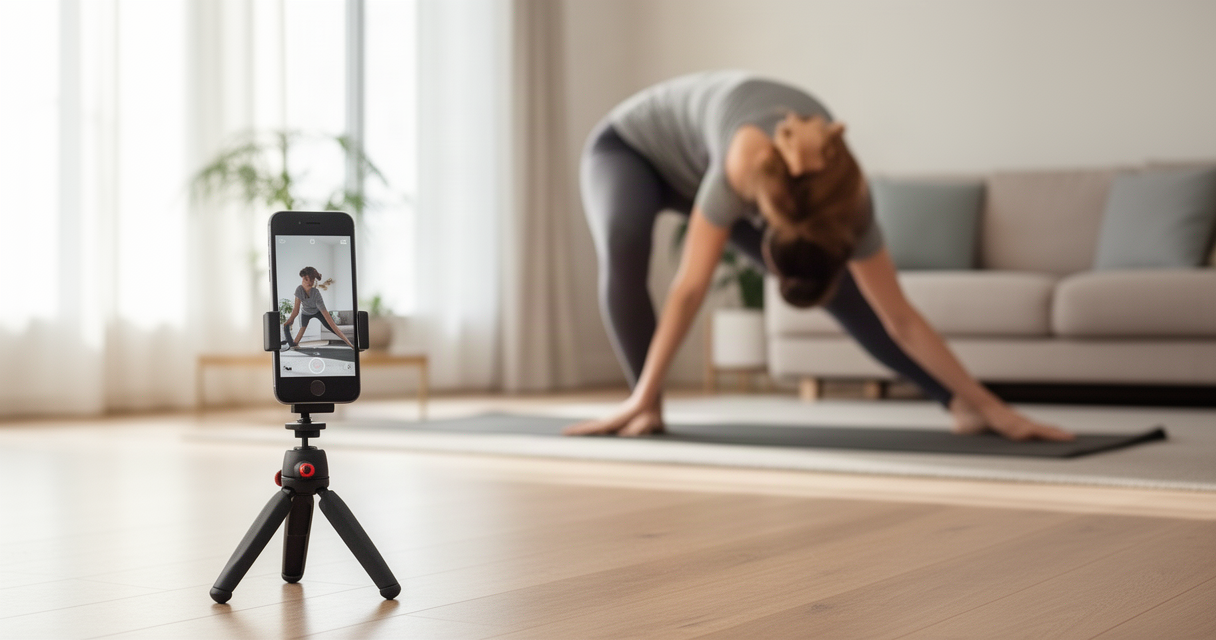
Every AI yoga app here runs the same basic pipeline. A camera feeds video into a pose-estimation model, the model plots a skeleton of joint positions frame by frame, and the app compares that skeleton to a stored reference pose for whatever asana is being practiced. When tracked joints drift past a threshold, the app fires a correction.
This is real technology, not vaporware — the same computer-vision category covered more broadly in the guide to AI form check apps that work without a spotter. It is good at catching gross, 2D deviation from a template: an elbow 40 degrees off, a hip that hasn’t rotated far enough.
What it cannot do is diagnose why a joint is out of position. It has no medical history, no sense of yesterday’s pain, no read on fatigue. Joint-tracking specs vary by app: Zenia tracks 16 joints through the front camera, per VentureBeat’s 2019 coverage of the launch. Skill Yoga tracks 17 joints via the selfie camera, per Skill Yoga’s own blog. Yogain tracks 14 landmarks at 30 frames per second, processed on-device, per Yogain’s site.
None of the three spec sheets claims anything about injury detection, because none of the apps are built to detect injury — only deviation from a template. Marketing any of them as a trainer replacement is where the category oversells itself.
Zenia vs Skill Yoga vs Yogain: AI Yoga App Comparison at a Glance
| Zenia | Skill Yoga | Yogain | |
|---|---|---|---|
| Platform | iOS, Android | iOS, Android | iOS, Android |
| Live instructor-led classes | No | No | Yes — 7 daily sessions |
| Joint/landmark tracking | 16 joints, front camera | 17 joints, selfie camera | 14 landmarks, 30fps, on-device |
| Pose modifications | None reported | Limited, athlete-focused | Beginner-structured, instructor-built |
| Reported price | About $15/month or $100/year (2019, per VentureBeat — reconfirm current pricing) | Reported to vary: about $6.99/month (per FitnessDrum) to about $17/month or $90/year (per an App Store reviewer) | Starts around ₹400/month, about $4.80 USD |
| Free trial | First month free (2019 pricing) | Not consistently disclosed pre-signup | 10-day trial, no card required |
The figures above come from vendor pages and reviewer reports at the time of writing. Prices shift; confirm current numbers in-app before subscribing.
Zenia: The App That Started the Category
Zenia launched in 2019 branded as the first AI-powered yoga assistant, per VentureBeat’s 2019 coverage. It uses the front camera to track 16 joints and does not save video of the practice session — a privacy detail worth noting for a category built around a camera pointed at someone in athletic clothes.
The most useful independent look at Zenia’s accuracy comes from a physical therapist writing for MyHealthyApple, who found that only large, gross 2D movements reliably triggered feedback — subtler misalignments slipped past the model. More significant: the review found no pose modifications were offered at all, which the reviewer flagged as “essential for beginners.”
The PT’s verdict was blunt: Zenia is “promising but does not replace live assistance from a trained instructor-led yoga studio.” That line is close to the honest ceiling for the entire AI-yoga category as it stands in 2026.
On pricing, VentureBeat’s 2019 reporting had Zenia offering a free first month, then about $15 a month or about $100 a year. That figure is years old now and should be reconfirmed directly in the app before assuming it still holds.
Skill Yoga’s Movement Coach: Pose Score, and What It Doesn’t Catch
Skill Yoga positions its Movement Coach toward a more athletic user than Zenia does. The selfie camera tracks 17 joints and rolls the result into a single “Pose Score,” summarizing how close a hold was to the reference pose rather than streaming individual corrections.
App Store reviews split on whether that works. One reviewer dealing with back pain reported the opposite of reassurance: the app aggravated the pain and, in their words, “will not teach you proper form,” adding that it felt “only geared towards young and advanced yogis.” That is a direct hit on the exact failure mode the pose-estimation limits predict — an app tuned to gross-deviation detection has no way to know a modification is medically necessary rather than optional.
Other reviewers were more positive: one noted simply that “the pose coach is pretty cool too,” describing it as a genuine value-add. The split isn’t really a contradiction. The Pose Score appears to work for students without pain and against students who need a modified pose.
Billing is the other recurring complaint. One App Store reviewer flagged that pricing — “$90 a year or $17 a month” — was only shown after signup. FitnessDrum’s coverage cited pricing around $6.99 a month at one point, which likely reflects a different tier or era rather than either source being wrong. Reported pricing for Skill Yoga varies; confirm the current number in-app before entering payment details.
Yogain: Cheapest, Most Beginner-Structured, Least Track Record
Yogain uses a different architecture: 14 landmarks tracked at 30 frames per second, processed on-device rather than server-side, per Yogain’s own site. The lower landmark count than Skill Yoga’s 17 doesn’t necessarily mean less accurate tracking — on-device processing trades model complexity for speed and privacy, and 30fps is adequate for static yoga holds.
What differentiates Yogain more than the tracking spec is the instructor layer behind the AI. The posture model was reportedly built using more than 500 hours of instruction from a Yoga Alliance certified instructor, Manisha, and the app pairs that model with seven daily live sessions, solo AI practice, and a weekly report on pose accuracy and weakest poses.
A Play Store review captured the appeal: “the sessions with Manisha are really calming. It feels like real online yoga classes at home.” That comment is about the live-class experience as much as the AI feature, and it points to Yogain’s real differentiator — the AI supplements a human teacher instead of standing in for one.
Pricing undercuts both competitors: plans start around ₹400 a month, about $4.80 USD, with a 10-day free trial that doesn’t require a card. Yogain is also the newest of the three, with the thinnest body of independent reviews, so less is known about how the AI correction holds up at scale compared to Zenia’s five-plus years in market. Beginners weighing structure and price should also check instructor-led on-demand libraries like the ones compared in Pilates Anytime vs. Alo Moves vs. The Pilates Class, which covers the same “how much human instruction do you actually get” question in an adjacent discipline.
Our Take: Which AI Yoga App Actually Catches Unsafe Form?
None of them — that’s the finding the evidence supports, not a hedge. All three apps compare a tracked skeleton to a reference pose and flag deviation; none assesses whether the pose is a good idea for the specific body attempting it. Deviation from a template and risk to an individual are different problems, and only one is solved here.
That doesn’t make the category worthless. It makes the category narrower than its marketing.
Pick Skill Yoga for the most mature solo pose-tracking on the market, and accept the billing friction that comes with it. The 17-joint tracking and Pose Score are the most developed correction system among the three, and reviewers who don’t need modifications report real value from it. It is not built to slow down or simplify for anyone who needs that.
Pick Yogain for a true beginner who wants structure with a human still involved, rather than AI running solo. Daily live sessions with a certified instructor, a posture model actually built from instructor input, and the lowest price of the three make it the most honest positioning in the category — it isn’t claiming the AI replaces a teacher, because a teacher is still teaching the live sessions. The tradeoff is a shorter track record.
Pick none of them as a sole feedback loop for anyone managing an existing injury, chronic pain, or a significant mobility limit. This is where the category’s limitation stops being theoretical. The Zenia review found zero pose modifications offered — “essential for beginners,” per the reviewing PT — and the Skill Yoga reviewer with back pain described the app aggravating existing pain rather than catching bad form. That is exactly the scenario where a wrong cue does damage, and exactly the scenario none of the three apps is built to handle.
Community sentiment agrees. One assessment on r/yoga was blunt about the incentive behind the category: “these people are not even interested in learning yoga… they want to sell subscriptions.” Another commenter on the same subreddit put the safety concern more directly: “AI usage without a proper/experienced person is a disaster waiting to happen especially in medical and health related stuff.” The backlash isn’t fringe, either — a thread titled roughly “F*%# AI in Yoga” pulled about 490 upvotes on r/yoga, and a separate thread proposing a sub-rule against “AI slop” pulled about 730.
The same template-versus-individual limitation shows up outside yoga, too — in the look at AI personal trainer apps and in AI running form apps like Ochy, Movaia, and RunForm. It isn’t a yoga-specific problem; it’s a computer-vision-versus-medical-history problem running across the whole AI form-correction category.
Frequently Asked Questions
Can an AI yoga app tell if a pose is unsafe for YOUR body, or just different from a reference image?
Just different from a reference image, based on every review examined here. Pose-estimation models plot joint coordinates and flag deviation from a stored template; they have no access to medical history, current pain, or the reason a joint is out of position. “Unsafe” and “off-template” get treated as the same thing because the software has no way to tell them apart.
Do AI yoga apps work for people with injuries or limited mobility?
Not safely as a standalone tool, based on the evidence here. The physical therapist reviewing Zenia found no pose modifications offered, and an App Store reviewer with back pain reported Skill Yoga aggravated existing pain rather than catching bad form. Anyone managing an injury is better served checking a dedicated mobility resource — the best prehab apps for athletes roundup and the GOWOD vs. Pliability comparison cover that use case directly — or getting one in-person assessment before an app corrects form solo.
Which app has the most accurate real-time pose correction?
Skill Yoga’s 17-joint tracking and Pose Score are the most developed system of the three on paper, and reviewers without pain or mobility limits report solid results from it. Accuracy claims from all three vendors are unverified by independent lab testing — the joint counts and frame rates come from each company’s own product pages, not third-party benchmarking.
Is a paid AI yoga app worth it over free YouTube if practicing alone?
The real-time correction is the differentiator — a YouTube video can’t see a body and adjust, while a pose-tracking app at least flags gross misalignment as it happens. Whether that’s worth paying for depends more on whether structure and accountability are the actual need, since none of the apps replace an instructor’s judgment either way.
What do AI yoga apps miss that a real instructor catches?
An instructor reads breath, effort level, and facial cues, and asks what a student feels — none of which a camera measures. A real instructor also knows a student’s injury history and adjusts a pose accordingly instead of pushing everyone toward the same template, precisely the modification step reviewers found missing from Zenia’s feedback loop.
The Bottom Line on AI Yoga Correction
All three apps do the same core job reasonably well: they tell a student when a tracked pose has drifted from a reference template. None tells a student when that reference pose is a bad idea for their specific body, because none is built to know that in the first place.
For anyone without an existing injury, Skill Yoga’s or Yogain’s free trial is worth the ten minutes it takes — treat the feedback as a rough directional guide, not a medical clearance. For anyone practicing around pain, an old injury, or a real mobility limit, book one session with an actual instructor before letting any app correct a pose alone. Get the modification right once, in person, then let the app maintain it.
The industry sells these products as an AI yoga trainer. What the evidence here actually shows is a very patient mirror — useful, occasionally sharp-eyed, but no substitute for someone who can explain why the mirror is showing what it’s showing.