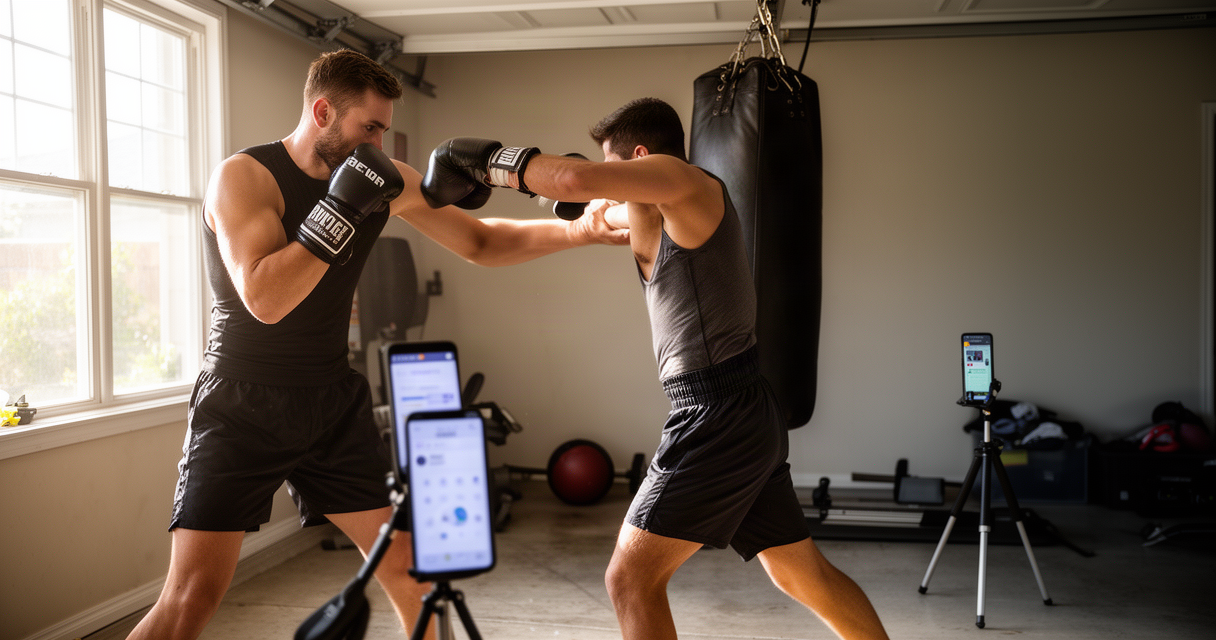
Solo boxing training used to mean shadowing a mirror and guessing. Now it means pointing a phone at a heavy bag and letting one of the AI boxing coach apps built for solo training tell you how you’re doing — which sounds like progress until the same six apps keep drawing the same conclusion review after review: the punch counting works, the coaching often doesn’t.
That gap matters because bad technique compounds. A boxer who drills a flawed cross for three months isn’t three months ahead — they’re three months into a habit that takes longer to unlearn than it took to build. An app that can’t actually see the flaw isn’t neutral. It’s actively unhelpful.
The short version: Combo AI is the strongest all-around pick for most solo trainers, largely because its on-device pose detection and free entry point remove the biggest risk of trying one of these apps — paying first, discovering the feedback is generic second. JAB AI is the best fit for anyone training more than boxing. FightCamp is worth a look only for people who want structured cardio-boxing workouts and don’t care about technique grading at all. None of them replace a coach, and the review data across the category backs that up specifically, not just as a disclaimer.
AI Boxing Coach Apps Compared: Punch Counter or Technique Coach?
The eight apps below split into two real categories, and confusing them is where most buyers get disappointed. Punch counters track volume, tempo, and calories — useful for training structure, not for fixing a dropped guard. Technique coaches claim to analyze form. That claim is the one worth scrutinizing.
| App | Category | Feedback Type | Price (check current listing) | Best For |
|---|---|---|---|---|
| Combo AI | Technique + gamified drills | On-device pose scoring, 7 metrics | Free tier; Premium reportedly $9.99/mo or $49.99/yr, 3-day trial | Beginners who want structure and don’t want to pay upfront |
| PunchIQ | Technique | Video-based, not real-time | Reportedly about $9.99/mo or $59.99/yr, 3-day trial (unverified) | Solo trainers wanting post-session breakdowns |
| JAB AI | Multi-discipline technique | Video upload, rep counting, issue flagging, 24/7 chat | Unconfirmed — reviewers call it pricier than in-person classes | Anyone training boxing alongside MMA, Muay Thai, or BJJ |
| Boxing AI (Ring Coach) | Technique + real-time cues | Voice cues live, video analysis post-session | Weekly/yearly/lifetime tiers, prices unconfirmed | People who want in-session audio coaching |
| Punch AI | Technique | Real-time CV tracking, drill modes, video breakdowns | Reportedly about $6.99/mo or $39.99/yr, 3-day trial (unverified) | Drill-focused solo training with mode variety |
| MotionFit | General fitness, boxing as one mode | Camera pose detection | Not independently confirmed | People who want boxing folded into a broader home workout app |
| TrainUpX | Combo caller, not a form checker | Voice-guided combo generation, iPad-first | Not independently confirmed | Bag work variety without technique grading |
| FightCamp | Wearable hardware, not camera AI | Motion-sensor punch tracking via wrist trackers | Hardware reportedly $400+ plus a required membership | People who want a structured cardio-boxing program, not form correction |
Two of these — MotionFit and TrainUpX — aren’t really “AI boxing coaches” at all once the marketing is stripped away. FightCamp isn’t camera-based AI at all. That’s worth knowing before comparing prices.
PunchIQ
PunchIQ positions itself as a video-based coach that reviews stance and balance, punch form and accuracy, guard and head movement, and footwork. It’s not real-time — the workflow is record, upload, review, which puts it closer to a virtual video-review session than an in-the-moment corrections tool.
Pricing reportedly runs about $9.99/mo or $59.99/yr with a 3-day trial, though that figure is unverified against the current App Store listing and should be checked directly before committing a card. One practical warning: searching “PunchIQ” online surfaces punchiq.ai, an unrelated construction-industry tool with no connection to the boxing app. Searching directly in the App Store, not a general web search, avoids that mix-up.
Independent user sentiment on PunchIQ specifically could not be verified for this piece — the review volume and third-party discussion around it are thin enough that no confident read on real-world accuracy exists yet. That’s a gap worth flagging rather than papering over with generic praise.
Combo AI
Combo AI runs entirely on-device — no video upload, no cloud processing — using pose detection to score sessions across seven metrics: Power, Speed, Rhythm, Footwork, Accuracy, Combos, and Endurance. The structure leans gamified: a 30-Day Combo Method, a 7-lesson library, tiers running Bronze to Legend, and a “Fighter Card” that tracks progress.
That gamification is a legitimate strength for beginners who need a reason to show up to the bag on day 12, not just day 1. The on-device processing also addresses a real privacy concern — punching video never leaves the phone.
The app is free to start, with Premium reportedly priced at $9.99/mo or $49.99/yr and a 3-day trial. Review volume is still thin relative to how long the app has been available, and the recurring complaint that does surface is about the “free” framing — enough of the useful content sits behind the paywall that some users feel the free tier oversells what’s actually free. Worth trying before assuming the free tier covers real coaching.
JAB AI
JAB AI covers more ground than a pure boxing app — boxing, MMA, Muay Thai, and BJJ all run through the same system. Training works by uploading video for rep counting and technique-issue flagging, backed by a 24/7 AI chat feature for questions between sessions.
Reviews split cleanly into two camps. On the positive side, one reviewer wrote: “I won’t say it’s 100% accurate but does its job well. Video tutorials in training plans are cherry on top!” Another, describing themselves as self-taught, put it this way: “As a self taught Martial Artist i find this incredibly useful for my techniques…” That’s a meaningful signal — self-taught practitioners without access to in-person correction are exactly the audience these apps are built for, and this is a case where a user reports real value.
The other camp is about cost. One reviewer’s complaint was blunt: “I couldn’t find no free version and its more expensive [than] my actual boxing classes day by day sheesh.” Paying more for a phone app than for actual class time undercuts the core pitch — that this is a cheaper alternative to a gym.
A third data point complicates the accuracy praise. The aggregator heavybag.pro names JAB AI among a group of apps that returned near-identical feedback regardless of what footage was uploaded, including professional fight footage. That’s covered in more detail below, but it’s directly relevant here: the same app earning “does its job well” from one user shows up in a documented pattern of generic scoring elsewhere. For anyone training multiple disciplines, the AI training tools for combat sports comparison covers how JAB AI and its BJJ-focused competitors stack up specifically on grappling feedback, which this analysis doesn’t get into.
Boxing AI (Ring Coach)
Boxing AI’s pitch is real-time voice cues delivered during a live session, paired with post-session video analysis of stance, movement, and punches, plus stats tracking over time. Pricing runs on weekly, yearly, and lifetime tiers, but none of the actual figures could be confirmed against a current, reliable source — treat any number circulating online as unconfirmed until checked on the app’s own listing.
One review aggregator ranks Boxing AI “Best Overall” in its category. That ranking deserves skepticism rather than deference — aggregator “best of” lists in this space are frequently built on affiliate relationships rather than hands-on testing, and this one doesn’t disclose its methodology.
There’s also a structural point worth making plainly: real-time voice cues don’t require the AI to see anything. A voice cue system can run on timers, pre-set combo sequences, or basic motion triggers without any actual computer-vision analysis of form. That’s not necessarily a criticism of Boxing AI specifically, but it’s a reason to weigh the “real-time AI coaching” language carefully rather than assuming voice feedback equals visual technique grading.
Punch AI
Punch AI runs real-time computer-vision tracking of punches and head movement, plus video upload for round-by-round breakdowns. It offers more training variety than most competitors: Combos, Sparring, Triangle Drill, and Off the Line modes, along with calorie tracking and a leaderboard for anyone motivated by competition.
Pricing is reportedly about $6.99/mo or $39.99/yr with a 3-day trial — again unverified, and worth confirming on the current App Store listing before subscribing. Early reviews on the video feedback feature are limited in number but positive within that small sample, which is a fair way to describe the current evidence: encouraging, not conclusive.
The mode variety is a real differentiator. A lot of the category treats “boxing training” as one undifferentiated activity; breaking it into combos, simulated sparring, and reaction drills better matches how an actual boxing session is structured.
MotionFit and TrainUpX
These two get grouped together because neither is really a boxing-specific AI coach, despite showing up in “best AI boxing app” searches.
MotionFit is a general home-workout app that uses camera pose detection across bodyweight training and running, with boxing as one mode among several rather than the core product. Anyone buying it specifically for boxing coaching is buying a feature, not a focus.
TrainUpX is more precisely described as an AI combo generator — it calls combos via voice guidance and structures power rounds, built iPad-first. It’s a combo-caller, not a form-checker. That’s a useful tool for varying bag work so sessions don’t get repetitive, but it isn’t doing anything resembling technique analysis.
Independent review data for both apps couldn’t be confirmed in enough volume to characterize real user sentiment. That’s stated plainly rather than filled in with generic claims — the honest answer here is “not enough evidence yet,” not a verdict either way.
FightCamp: The Hardware Outlier That Isn’t Camera AI at All
FightCamp doesn’t belong in a pure app comparison, but it comes up constantly in the same searches, so it’s worth addressing directly: FightCamp is not phone-camera AI. It’s a wearable system — wrist trackers with motion sensors — paired with a connected bag and app.
According to FightCamp’s own technology page, the system’s punch recognition was trained on data from more than 100,000 punches, capturing roughly 1,200 data points per second through a 6-axis IMU (inertial measurement unit) in the trackers. That’s a legitimate engineering claim from the company, distinct from the unverified pricing figures floating around the rest of this category.
The hardware itself reportedly starts around $400, plus a required ongoing membership — a meaningfully different cost structure than a $10/month app, and worth checking against FightCamp’s current pricing page before assuming that figure holds.
Reviews split along a predictable line. One user described the appeal well: “The trackers and app make it feel like I’m getting real feedback on my punches and combos, not just hitting the bag and guessing…” That’s a fair description of what FightCamp is good at — structure, motivation, and a sense of measurable progress for cardio-focused training.
A more experienced, gym-trained reviewer drew a sharper line: “If you expect to learn any real fighting fundamentals… then pass on this system… Fightcamp is a toy at best.” That’s a pointed assessment, but it lines up with what the hardware is actually built to measure — punch volume and power via wrist motion, not stance, guard position, or footwork. There’s also a recurring complaint that some workouts are locked without an active tracker connected, which limits the app’s usefulness as a standalone product.
The Complaint Nobody’s Telling You: Feedback That Doesn’t Change
The single most consistent problem across this category isn’t pricing or missing features. It’s that the feedback often doesn’t change no matter what’s actually happening in the footage.
The aggregator heavybag.pro documented this directly, tracking near-identical feedback across BRAWLER, Boxer AI, and JAB AI — including when professional fight footage was uploaded to test the system. Scores plateaued regardless of actual improvement, which is a specific, falsifiable finding, not a vague complaint about “accuracy.”
BRAWLER — a comparable boxing app outside this list of eight, cited here as corroborating pattern evidence rather than a review of any featured app — puts a number on the frustration. One App Store reviewer wrote: “I spent $59 to sign up, and almost immediately I could tell this app isn’t worth $0.59… it couldn’t detect my punches more than half the time. And the feedback it provided? ‘Improve your punches.’” Another reviewer of the same app described the pattern even more precisely: “seems like it says a lot of the same things no matter how well you do them.”
That second quote is the real diagnosis. Feedback that doesn’t respond to actual changes in performance isn’t coaching — it’s a random-quote generator dressed up as analysis. A boxer who improves their guard and gets the same note as before has no way of knowing whether the app registered the change or is just cycling stock phrases.
There’s a defensible line to draw here rather than dismissing the whole category. Punch counting — how many punches landed, at what rough tempo — is reasonably reliable in a controlled setup: front-facing camera, good lighting, clear framing of the bag. Technique grading — is the guard dropping, is the weight transferring correctly — is a fundamentally harder computer-vision problem, and nothing in the current evidence suggests any app on this list has solved it reliably. Punch counters counting punches: fine. Technique coaches grading technique: unproven.
What None of These Apps Can Catch
Three specific flaws sit outside what a single phone camera can reliably see, regardless of how good the underlying model is:
- Back-foot weight transfer. A phone positioned to frame the whole body loses the resolution needed to judge subtle weight shift from the rear foot through a punch — the detail that separates a powerful cross from an arm punch.
- Wrist alignment on impact. The moment of contact happens too fast and at an angle most home setups can’t capture cleanly, which matters directly for injury risk.
- Guard dropping under fatigue. Form degrades late in a round exactly when a fighter is too tired to self-correct — and that’s also when most camera angles are worst-positioned to catch it, since fatigue changes body position relative to the frame.
Boxers training without a gym are aware of this gap. One poster in r/amateur_boxing framed the underlying anxiety plainly: “Just started boxing recently… I don’t want to build bad habits or think I’m improving when I’m actually doing things wrong.” That’s the exact risk an unreliable technique grader creates — not just wasted time, but false confidence in a flawed pattern.
Other posters in the same community land on a workable middle ground rather than rejecting camera-based self-review outright. One described it directly: “Recording bag work or shadow boxing is a good method… concentrate on fixing that for a few weeks and keep checking on your camera footage.” That’s a manual version of what these apps are trying to automate — self-recorded footage, reviewed with intent, focused on one flaw at a time rather than a global “improve your punches” score.
Another comment gets at what no app replaces: “you’ll improve way faster if you can get any coaching touchpoint again, even a session here and there.” Periodic access to a real coach — even occasional, even a single session to catch what months of solo footage can’t — moves the needle more than any subscription tier.
For readers curious whether this limitation is boxing-specific or a broader problem with camera-based form correction, how AI form-check apps hold up in other sports covers the same core issue in a different sport, and the pattern holds: cameras are good at counting, weak at grading nuance.
Our Take: Who Should Use an AI Boxing Coach App for Solo Training
An AI boxing coach app makes sense for one specific situation: someone who cannot currently access a gym or a coach, wants structure more than perfection, and understands the tool is tracking effort and volume, not certifying correct form.
That’s a real and common situation, and it’s a legitimate use case — not everyone lives near a boxing gym, and not everyone can afford weekly private sessions. For that person, Combo AI’s free tier and on-device processing remove the two biggest risks in this category: paying before testing, and footage leaving the device. Its gamified structure also solves the actual problem most solo trainers have, which isn’t technique — it’s consistency.
For anyone training across disciplines rather than pure boxing, JAB AI’s coverage of MMA, Muay Thai, and BJJ makes more sense than a boxing-only tool, provided the pricing complaint is weighed against local class costs first. Combat-sports crossover training has its own considerations worth checking against the AI training tools for combat sports roundup before committing to one platform.
What none of this changes: solo training with any of these apps should be treated as a supplement to occasional real coaching, not a substitute for it, the same conclusion reached in the broader best AI personal trainer apps comparison across other training categories. The evidence from this category — plateaued scores, generic feedback, blind spots on the exact mechanics that cause injury — doesn’t support treating any of these apps as a standalone coach. It supports treating them as a bag-work log with occasional useful nudges.
Anyone specifically worried about form-check reliability without a spotter present should also read the dedicated breakdown of best AI form-check apps without a spotter, which covers the accuracy question across strength training too — the same core limitation shows up there.
Frequently Asked Questions
Can an AI boxing app replace a coach?
No. The documented pattern across this category — plateaued scores, near-identical feedback regardless of actual technique changes — shows these apps are not reliably grading form the way a trained eye can. They’re better suited to tracking volume, tempo, and consistency than to certifying correct technique.
Are these apps accurate at reading punch form, or just counting punches?
Punch counting in a controlled setup — front-facing camera, good lighting, clear framing — is reasonably reliable across most of these apps. Technique grading, like guard position or weight transfer, is a much harder problem, and no app in this comparison has strong independent evidence of solving it consistently.
Is it safe to learn boxing solo with only an app?
It’s workable for building volume and rhythm, but risky for foundational technique, since injury-relevant details like wrist alignment on impact are exactly what a phone camera struggles to catch. Periodic access to an in-person coach, even a single session, catches errors that months of solo app-based training can miss.
What’s the best free AI boxing app for beginners with no gym?
Combo AI has the strongest free entry point in this comparison, with on-device processing and a full free tier before any paywall. It won’t replace a coach, but it’s the lowest-risk way to start structured solo training without paying upfront.
Do these apps work for Muay Thai or just boxing?
Most on this list are boxing-only. JAB AI is the exception, covering boxing, MMA, Muay Thai, and BJJ within one platform, which makes it the more relevant option for anyone training across combat sports rather than boxing exclusively.
The Real Verdict on AI Boxing Coach Apps for Solo Training
These apps work best as training wheels for people who genuinely can’t get to a gym — not as a coach substitute for anyone who can. Start with Combo AI’s free tier to test whether the structure and gamification actually get used consistently, since consistency, not technique grading, is the real problem most solo trainers are solving. Then budget for at least one real, in-person form check down the line, even a single session, to catch what a phone camera structurally can’t.
The fitness industry has always sold shortcuts around needing a real coach — this is just the version with a camera and a subscription.