Every VBT sensor’s landing page implies the same thing: real data costs $400, and the free camera apps are toys for lifters who can’t afford to be serious about training.
That assumption is expensive to get wrong in either direction. Spending $400 on hardware that wasn’t necessary is one mistake. Trusting a free app that’s quietly generating garbage numbers — numbers being used to decide how hard to train that day — is a worse one.
A peer-reviewed 2024 study measured four VBT tools against Vicon 3D motion capture, the actual gold standard for movement measurement, and found that one free app, QwikVBT, matched the validated $399 RepOne sensor on mean-velocity accuracy. Two other free apps in the same study, Metric VBT and MyLift, did not reach that bar. “Free apps are less accurate” turns out to be true for some free apps and false for others. It is not a blanket rule, and it doesn’t make the $400 sensors pointless either.
What follows is what the data actually says, what real lifters report once these tools leave the lab, and who should spend the money versus who should skip velocity-based training entirely.
What VBT Actually Measures (and Who It’s For)
Velocity-based training measures mean concentric bar velocity on each rep. The load-velocity relationship — heavier loads move slower, lighter loads move faster, and that relationship is fairly consistent for a given lifter and lift — lets a velocity number stand in for effort more objectively than perceived exertion does.
The practical use case is autoregulation through a velocity-loss threshold. A lifter picks a percentage drop-off from their fastest rep in a set — commonly somewhere in the 10-30% range depending on whether the goal favors strength/power or hypertrophy-style volume, per research on velocity-loss thresholds published in PMC7558277 — and stops the set once velocity drops past that line. Training volume adjusts to how the lifter is actually performing that day, rather than following a rep count decided a week in advance.
That’s a real tool for a specific group. Competitive lifters chasing marginal precision, people training alone with no coach in the room to eyeball bar speed, and lifters who have a documented history of misjudging their own effort all stand to gain something from it.
It is not a tool most lifters need. Beginners on a linear progression get nothing from measuring bar speed that a simple “did the weight go up” check doesn’t already tell them. Lifters who are already accurate and consistent with rate of perceived exertion are paying money and adding logging overhead to replicate a skill they already have. The fitness industry has always had a talent for selling instrumentation to solve problems that discipline and a program already solve for free, and VBT hardware is not automatically exempt from that pattern just because the underlying science is real.
The Study Nobody Selling a $400 Sensor Will Show You
The relevant paper is Renner, Mitter, and Baca, published in PLOS One in November 2024 (PMC11575817). Twenty competitive powerlifters performed squat, bench, and deadlift up to 90% of their competition max while four tools recorded mean velocity simultaneously: QwikVBT, a free computer-vision app; Metric VBT, another free computer-vision app; MyLift, a third free app; and RepOne, a linear transducer priced at roughly $399. Vicon 3D motion capture — the reference standard used in biomechanics research — ran alongside all four as the ground truth.
Two tools came out validated. QwikVBT and RepOne both produced mean-velocity readings that matched Vicon closely enough to be considered accurate: systematic bias between 0 and 0.21 m/s and RMSE between 0.01 and 0.04 m/s across all three lifts, with zero missed or phantom reps recorded by either tool. Metric VBT and MyLift did not reach that same validity threshold in this study.
A separate paper adds useful context on one of the apps that fell short. A 2024 study out of Deakin University, published in PeerJ (PMC11283170), found that Metric VBT correctly detects more than 95% of reps — it’s not failing to see the reps happen. But it showed “poor to moderate agreement” with Vicon specifically on the mean-velocity number, with the error growing larger at higher bar speeds. That’s the exact number VBT autoregulation runs on. An app can be excellent at counting reps and still be the wrong tool for deciding when to stop a set.
This mirrors a pattern seen elsewhere with free AI apps validated against gold-standard measurement: the results don’t clear every bar at once. Accuracy runs tool-by-tool, and sometimes metric-by-metric within the same tool, rather than following one pass/fail line for the whole category. “Free apps are less accurate than sensors” is the kind of claim a vendor selling a $400 sensor has every incentive to repeat without qualification, especially without naming which specific free app actually cleared the bar and which didn’t.
QwikVBT vs RepOne vs Vitruve vs Metric VBT: Price and Feature Comparison
Pricing below is approximate as of 2026 — VBT hardware pricing moves with sales and referral codes, so verify current numbers on each vendor’s site before buying.
| Tool | Type | Price | Validated vs Vicon (PLOS One 2024)? | Setup Required | Live In-Set Feedback | Platform |
|---|---|---|---|---|---|---|
| QwikVBT | Computer-vision app | Free, with a one-time unlock of about $27.99 | Yes | Tripod, consistent camera angle | No audio feedback mid-set | iOS/Android |
| RepOne | Linear transducer + free app | About $399 | Yes | Magnetic bar attachment | Yes | iOS/Android |
| Vitruve | Linear transducer + free app | About $447 (team/coach plans roughly $620-$1,251/year) | Not included in this study | Magnetic bar attachment | Yes | iOS/Android |
| Metric VBT | Computer-vision app | Free | No (PeerJ 2024: poor-to-moderate mean-velocity agreement) | Tripod, consistent camera angle | No | iOS/Android |
QwikVBT’s “free” label carries a real caveat worth flagging before anyone buys on that basis. According to reviews on the Google Play listing, an app-store reviewer reports that “all the useful features are now locked behind an £18 paywall,” referring to a mid-2026 update that moved core functionality behind that one-time unlock. The free tier is also capped at a limited number of sets per day. It’s still dramatically cheaper than any hardware option, but “free” and “free with a small unlock fee” are different pitches, and both belong in the comparison.
What Real Lifters Say When the App or Sensor Actually Ships
Accuracy data describes a lab. Reliability describes a Tuesday leg day, and the two don’t always agree.
A detailed long-form review of the RepOne, posted to r/homegym after four weeks of daily use, calls the device well-built and unobtrusive, and is direct about who actually needs it: “The RepOne sensor retails for about $400… Do you ‘NEED’ this? No. Absolutely not… If you are fairly accurate at judging RPE, RPE will get you 80% of the way there, maybe 90% of the way there. You don’t NEED this.” That’s a $400-hardware owner making the case against assuming everyone needs $400 hardware.
The same thread has less flattering commentary buried in the comments. One commenter describes the RepOne app failing to register roughly half their reps: “The app is so terrible. Maybe 50% of the time it will not register your reps and fail to save the video… The device also disconnects from the phone fairly often. I’ve spoken with their support so many times and they promise time and time again it will get better… But nothing happens.” A second commenter reports nearly identical complaints about Vitruve, calling it “a HUGE waste of money” after describing sessions lost entirely when the device disconnected mid-set.
Vitruve’s own App Store page corroborates that pattern independently. One reviewer writes: “App constantly crashes. Doesn’t record any data due to the crashes. Avoid Vitruve for velocity meters. No longer viable.” Paying $400-plus does not appear to buy immunity from software bugs.
QwikVBT’s app-store reviews skew more positive on balance. One reviewer directly cross-checked it against hardware: “I found the app more valuable than vbt device as it can give metrics along with video feedback. I tested its metrics with the vbt device, accurate and can be used for research purpose.” Another, identifying as a strength and conditioning coach, writes that “spending too much money on getting precise data to provide an optimised program for our athletes is sometimes hard, but this is a game changer” — a working coach, not a hobbyist, treating the free tool as a legitimate budget alternative.
None of this is representative data. It’s individual reviews describing individual experiences, and the sample sizes are small on every side. But the consensus across both hardware options is consistent enough to matter: expensive and reliable are not the same word, and accuracy and reliability are two separate questions vendors have every reason to blur together.
The Real Tradeoffs: Setup Hassle, Live Feedback, and Reliability
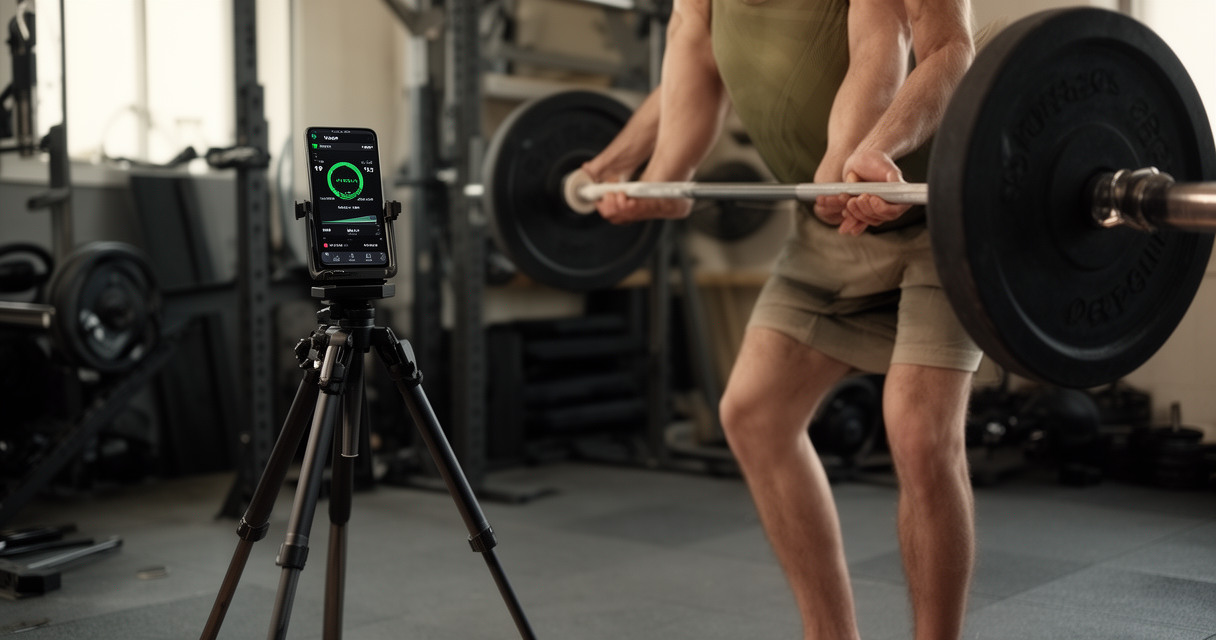
Camera-based apps come with a real setup cost. They need a tripod, a consistent camera angle, and decent lighting to work as tested. The PeerJ 2024 study specifically evaluated multiple camera angles — 0°, plus or minus 10°, plus or minus 20° — because angle measurably affects the readings. That’s a genuine hassle at a crowded commercial gym where propping up a phone at a fixed angle for every set isn’t always practical.
Hardware sensors solve that problem by design and add a real advantage on top: live audio or visual velocity feedback during the set, without checking a phone propped up across the room. A Vitruve App Store reviewer describes exactly this benefit: “The ability to get velocity read outs with endless metrics is fantastic. Love being able to hear the speed with the voice read out.” That is not a marketing gimmick. Reacting to velocity mid-rep is meaningfully different from reviewing it after the set on a screen.
Hardware also has no camera-angle dependency and functions independent of framing or lighting — though the reliability complaints in the previous section show that advantage is smaller in practice than the pitch suggests, since a disconnecting Bluetooth sensor creates its own kind of friction.
Free apps flip that tradeoff. They eliminate Bluetooth pairing entirely, which removes one of the most frequently reported failure points across both the RepOne and Vitruve reviews above. What they cost in setup friction, they save in one whole category of hardware failure.
Neither format is “set and forget.” Both require building an actual habit of checking and acting on the numbers, and that adoption hurdle exists regardless of what the lifter paid to get the data.
Our Take: Who Should Use the Free App, Who Should Buy the Sensor
There is no single winner here — a universal verdict would ignore how differently self-coached lifters actually train.
A self-coached lifter deciding whether VBT is worth trying at all should start with QwikVBT specifically — not “a VBT app” in the abstract — because it is the one free option with peer-reviewed evidence that it matches validated hardware on mean-velocity accuracy. The downside risk is a one-time unlock of about $27.99, not a $400 purchase that might sit in a drawer after a month.
A lifter who already knows they want VBT long-term has a real case for RepOne or a comparable linear transducer. Training solo with nobody to prop up a phone at the right angle, wanting live audio feedback mid-set, or coaching multiple athletes remotely are all legitimate reasons to pay for hardware. That purchase buys convenience and real-time feedback QwikVBT doesn’t offer — not necessarily accuracy QwikVBT is already delivering, per the PLOS One data.
A lifter who is comfortable and consistently accurate with RPE, or a beginner still on a basic linear progression, should skip both options. This is a tool built for a specific autoregulation problem, not a required part of training. It pairs naturally alongside autoregulation and RPE-based programming apps rather than replacing the judgment those tools already build.
Metric VBT and MyLift are worth avoiding for anything beyond rough rep counting based on the current published data. That could change if either developer closes the validity gap in a future update — worth rechecking before trusting either one for actual load decisions.
Frequently Asked Questions
Is a free VBT app as accurate as a $400 velocity sensor?
It depends entirely on the specific app, not the price tag or the free-versus-paid label. PLOS One 2024 found QwikVBT (free) matched RepOne (about $399) on mean-velocity accuracy against Vicon 3D motion capture. Metric VBT and MyLift, also free, did not reach that same validity in the same study.
Do lifters actually need velocity-based training?
Not universally. VBT is an autoregulation tool built around velocity-loss thresholds, and it’s most useful for lifters training solo without a coach’s eye or lifters who have historically misjudged their own RPE. A long-form RepOne reviewer on r/homegym put it plainly: accurate RPE gets most lifters “80%, maybe 90% of the way there” for free. VBT is a refinement on top of that, not a requirement to start.
What’s the actual difference between QwikVBT, Metric VBT, and MyLift?
All three are free or near-free smartphone computer-vision apps, but only QwikVBT was shown valid for mean velocity against Vicon in PLOS One 2024. Metric VBT detects more than 95% of reps correctly per PeerJ 2024 but shows poor-to-moderate agreement on the velocity numbers themselves. MyLift also underperformed against Vicon in the same PLOS One comparison.
Is RepOne or Vitruve the better choice for a home gym?
Both are linear transducers in the $400-450 range with similar core functionality, and both have documented app reliability complaints in independent reviews — missed reps, Bluetooth dropouts, crashes, forced re-logins. Only RepOne was included in the PLOS One 2024 validation study alongside QwikVBT. Verify current pricing and check recent app-store reviews for stability before choosing either.
What are the real downsides of a phone-camera VBT app compared to a sensor?
Camera apps need a tripod and a consistent camera angle — the PeerJ 2024 study specifically tested multiple angles because angle affects accuracy — which is awkward to maintain at a busy commercial gym. They also can’t provide live audio feedback mid-set the way hardware sensors can. Hardware trades that convenience for a higher price and its own documented reliability issues.
The Sensor Was Never the Snake Oil
If the goal is trying VBT before committing money to it, QwikVBT is the one free app with actual peer-reviewed evidence it matches a $400 sensor on the number that matters for autoregulation. That doesn’t make the sensors pointless for lifters who want live feedback and zero camera-angle hassle, and it doesn’t mean every lifter needs VBT at all.
A practical next step: run QwikVBT’s free tier for a couple of weeks with a consistent tripod setup, logged alongside whatever workout logging apps like Hevy or Strong already track sets and loads, before deciding whether the accuracy and convenience justify $400 in hardware. Anyone deciding VBT isn’t worth the setup at all is also a candidate for the broader category of AI computer-vision tools that replace a spotter or coach, which solve a related but different problem.
The $400 gadget was never the snake oil here. The assumption that every free app is automatically worse was.
References
- Renner, Mitter & Baca (2024), “Concurrent validity of different velocity-based training devices,” PLOS One — https://journals.plos.org/plosone/article?id=10.1371%2Fjournal.pone.0313919 (also PMC11575817 — https://pmc.ncbi.nlm.nih.gov/articles/PMC11575817/)
- Trowell et al. (2024), Deakin University, PeerJ — https://peerj.com/articles/17789/ (also PMC11283170 — https://pmc.ncbi.nlm.nih.gov/articles/PMC11283170/)
- Velocity Loss Thresholds Reliably Control Kinetic and Kinematic Outputs during Free Weight Resistance Training — PMC7558277 — https://www.ncbi.nlm.nih.gov/pmc/articles/PMC7558277/
- Sportsmith, “VBT vs Traditional Loading: Finding the Best Approach” — https://www.sportsmith.co/articles/vbt-vs-traditional-loading-finding-the-best-approach/
- RepOne Strength, product page — https://www.reponestrength.com/repone-hardware
- r/homegym, RepOne velocity tracker long-form review and comments — https://reddit.com/r/homegym/comments/11dvudm/review_repone_velocity_tracker/
- Vitruve / SimpliFaster, encoder listing — https://store.simplifaster.com/product/vitruve-vbt-encoder/ ; https://vitruve.fit/
- Google Play, Qwik VBT: Velocity Bar Tracker — https://play.google.com/store/apps/details?id=com.zopfi.qwik_vbt&hl=en
- Apple App Store, Qwik VBT: Velocity Bar Tracker — https://apps.apple.com/us/app/qwik-vbt-velocity-bar-tracker/id1660094818
- Apple App Store, Vitruve — https://apps.apple.com/us/app/vitruve/id6535689778