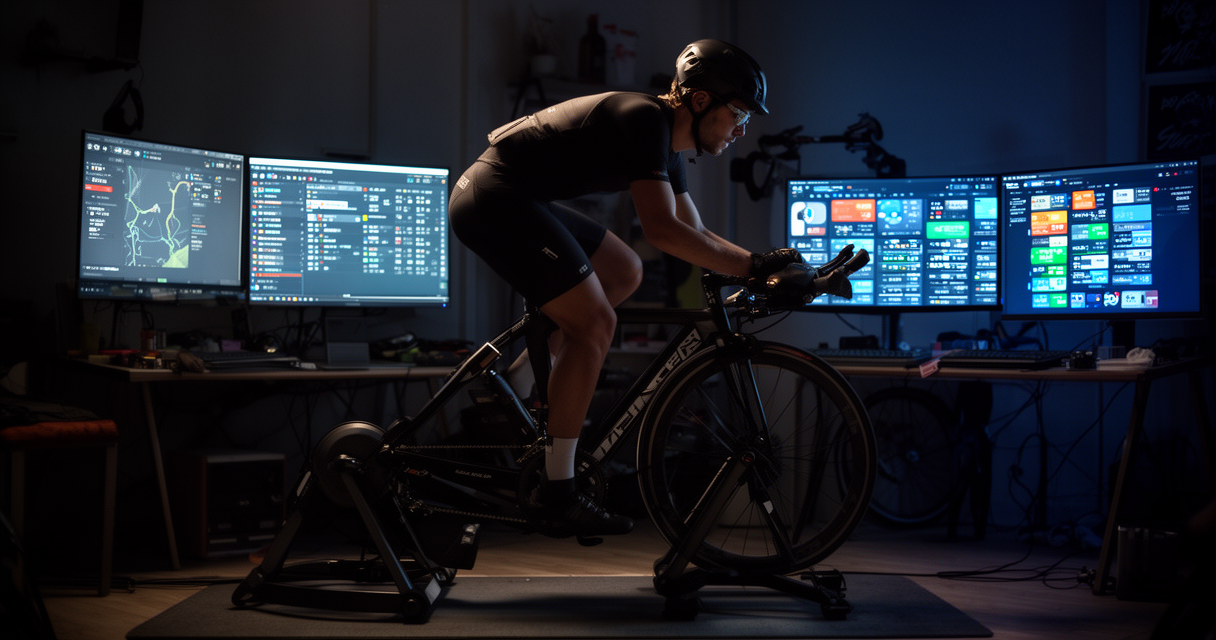
Three indoor cycling subscriptions, three different jobs, and a combined sticker of about $580 a year if a serious cyclist runs all of them. The honest comparison is not feature-by-feature — it is which one earns its keep.
Indoor cycling app pricing climbed twice in the last eighteen months. Zwift moved to $19.99 a month in 2024. Wahoo SYSTM moved to $17.99 a month in October 2025. Stacking the three is now a $40-50/month decision, not a $20 one.
TrainerRoad ($209.99/yr) is the only one of the three that earns its keep as a structured training tool. Zwift ($199.99/yr) is a $200 entertainment subscription dressed up as training. Wahoo SYSTM ($179.99/yr) has the best diagnostic test of the three but the smallest workout library — pay for the test, not the plans. For self-coached riders who already own a Garmin head unit, intervals.icu plus the Daily Suggested Workout covers most of the job for free.
The 2026 pricing math, the 4DP claim, what serious riders on r/Velo and r/cycling actually report, and a per-profile verdict follow below.
The 2026 Pricing — What Stacking Actually Costs
The headline numbers, pulled from each platform’s official pricing page in June 2026:
| App | Monthly | Annual | Last hike |
|---|---|---|---|
| TrainerRoad | $21.99 | $209.99 | January 2023 |
| Zwift | $19.99 | $199.99 | June 2024 |
| Wahoo SYSTM | $17.99 | $179.99 | October 2025 |
| Combined annual | — | $589.97 | — |
The stacked annual is the number worth sitting with. $589.97 is more than a year of premium Strava plus Garmin Connect+ plus TrainingPeaks Premium combined. It is more than a mid-range power meter pedal upgrade. It is also more than most cyclists realize they spend, because the three subscriptions hit different cards on different days.
Stacking is not theoretical. A rider on r/cycling described the exact setup: “I have a TR sub for structured training, and a Zwift sub so I can ride my TR structured workouts in an engaging ‘game’ environment.” That is the $410/year configuration. Add SYSTM for the 4DP test and it crosses $580.
Free or near-free alternatives exist and most riders ignore them. Intervals.icu is free with a $20/yr donation tier. MyWhoosh is free, with caveats noted later. Garmin Cycling Coach is free with any Edge or compatible watch. None of these have a marketing budget, which is why none of them appear in most “best of” lists.
TrainerRoad: The Only One Built as a Training Tool
TrainerRoad’s Adaptive Training system was built on a dataset of over 250 million completed workouts. After each session, the rider answers a five-option post-workout survey — very hard, hard, moderate, easy, all-out — and the next workout adjusts. Outdoor rides pulled from Strava feed the same model. The plan reshapes itself around the rider, not the other way around.
There are no avatars. No group rides. No confetti. The workout screen shows a power target line and the rider’s actual power, and that is it. For some riders this is the appeal; for others it is the reason to leave.
The structured plans are organized around event date, available weekly hours, and discipline. Road criterium, gravel A-race, XCO mountain bike, triathlon — each has its own progression. Plans integrate with Zwift in workout mode, so a paid TR subscriber can overlay the TR session on Wattopia and get both the prescription and the screen entertainment for $410/year.
What r/Velo riders say about TR sounds like this:
“I signed up for Trainerroad and don’t really think about it anymore.” — r/Velo training discussion
“Basically I don’t think about it that much because TrainerRoad takes care of most of it for me.” — r/Velo training discussion
Both quotes describe the same thing: friction removal. The rider stops deciding what to do today. TR decides. For a self-coached athlete with 8-15 weekly hours and a target event, that is the entire value proposition, and at $17.45/month on the annual plan it is the most defensible single subscription of the three.
The opinion case for TR is not subtle. It is the only one of the three an honest analyst would recommend to a serious cyclist if subscription cost were not a factor.
Zwift: A $200/Year Entertainment Subscription
Zwift is genuinely good at being Zwift. The racing scene is the largest indoor racing community on the planet. Group rides run twenty-four hours a day across categories. Route badges, jerseys, and the climb portal give riders something to chase. None of this is in dispute.
What is in dispute is the framing. Zwift markets itself as training; serious riders consistently report it is entertainment that happens to spin pedals. A multi-year Zwift user on r/IndoorCycling captured the positive case bluntly: “The racing will also move your fitness on loads, most of my highest power numbers come from Zwift races. They definitely push you on.” Racing on Zwift is a workout. Following Zwift’s structured plan is, in the words of one r/cycling rider running all three platforms, “in my opinion, just ok.”
The same rider’s summary — “Zwift is best for creating an immersive environment for indoor riding. The social aspects like group rides and races are a big part of the benefit. The workouts and plan are, in my opinion, just ok” — is the consensus on r/cycling and r/Velo combined. Zwift sells the environment. The plans are an add-on.
The friction is real for riders who want the workout without the environment. From an r/IndoorCycling thread on quitting Zwift: “My personal preference is to not have random ‘thumbs up’ and confetti and icons that I don’t understand popping into an already crowded screen with leaderboards and encouraging me to race people. Most of the time I’m just trying to listen to an audiobook or podcast!”
That is two different products. Both legitimate. Only one is structured training. Calling Zwift a coach is a category mistake — it is closer to the entertainment/follow-along category occupied by Apple Fitness+ and Peloton than to TrainerRoad. It is closer to a streaming service than to a training plan.
For a crit racer or a dedicated Zwift racer doing two or three hard races a week, Zwift alone is the right answer. The races are the workouts. Adding TR on top is paying $209 for a plan that the races will overwrite.
For everyone else, Zwift is a $200 entertainment subscription. Worth it for riders who genuinely use the environment to grind out base miles they would otherwise skip. Not worth it as a training tool.
Wahoo SYSTM: Best Test, Smallest Library
Wahoo bought The Sufferfest in 2019, spent two years rebuilding it, and relaunched as SYSTM in 2021. The narrative-driven workout videos with characters and music — Half is Easy, Nine Hammers, Violator — are still there. So is the diagnostic that distinguishes SYSTM from the other two.
The 4DP (Four-Dimensional Power) test profiles four metrics in a single ninety-minute session: Neuromuscular Power, Maximal Aerobic Power, Functional Threshold Power, and Anaerobic Capacity. Every prescribed workout afterward targets these four numbers individually rather than scaling everything off FTP. For a rider whose 5-minute power is disproportionately low relative to FTP, the plan responds. For a rider with a strong sprint and weak threshold, the plan responds differently. This is the genuine product advantage. It is also the only good reason to keep a SYSTM subscription past month one.
One r/Velo rider’s account of using 4DP this way:
“I use wahoo systm for my workouts (especially on the trainer)… Which workouts I’m doing in a given training block is something I generally decide based on goals I make after doing a 4DP assessment. For instance, my 5 minute power was disproportionately low compared to my FTP and 1 minute power when I did an assessment in the late fall, so my winter training focused a lot on improving my 5 minute power.” — r/Velo
That is the playbook. The workout library is smaller than TR’s, the structured plans are less rigorously progressive, and the narrative videos are an acquired taste. The diagnostic, however, is real.
The October 2025 price hike to $17.99/month eroded SYSTM’s positioning as the cheap alternative. At $179.99/year it now sits within $30 of TR for a fraction of TR’s training depth. The honest move for most riders interested in 4DP is to subscribe for one quarter, take the test, build a plan around the four numbers in any other tool, and cancel.
Head-to-Head: Where Each Wins
| Dimension | TrainerRoad | Zwift | Wahoo SYSTM |
|---|---|---|---|
| Structured training plans | Best | Weakest | Middle |
| Race-day specificity (Ironman, gravel) | Best | Weakest | Middle |
| Diagnostic accuracy | Ramp test (good) | FTP test (basic) | 4DP (best) |
| Group rides / racing | None | Only option | None |
| Yoga, strength, mental | None | None | Only option |
| Workout library depth | Largest | Large | Smallest |
| Garmin / Wahoo head unit integration | Strong | Strong | Tightest with Kickr |
| Cost per useful training feature | Best | Worst | Middle |
| 2026 annual price | $209.99 | $199.99 | $179.99 |
The verdicts are not hedged. TR wins on training. Zwift wins on environment. SYSTM wins on the test. No row produces “all three are great” because that is not what the riding population reports.
Per-Profile Verdict
The Ironman or A-race builder. TrainerRoad plus TrainingPeaks Premium. Skip Zwift unless the visual is needed to grind out long Z2 blocks indoors during winter. Skip SYSTM unless 4DP testing is a genuine part of the diagnostic process. Combined cost: $309/yr for TR + TP, plus an optional $199 Zwift sub if the environment is the difference between training and not training.
The crit racer or dedicated Zwift racer. Zwift only. Two or three Zwift races per week are the workouts. A TR plan layered on top will get overwritten by race recovery anyway. Combined cost: $199.99/yr.
The hybrid lifter-cyclist with 3-6 weekly riding hours. Wahoo SYSTM. The 4DP test plus yoga and strength channels match the cross-training reality. TR’s plans are calibrated for athletes with 8+ hours, and most of the prescription gets ignored. Combined cost: $179.99/yr.
The minimalist self-coached cyclist with a Garmin Edge. None. Intervals.icu (free), Daily Suggested Workout on the Edge (free), and a Friel-style block plan written on paper deliver the same outcome the three apps are charging $200-590/yr for. Combined cost: $0-20/yr.
The triathlete on a multi-sport budget. TrainingPeaks Virtual, included with TrainingPeaks Premium at $19.95/month, covers ride, run, and swim from a single subscription. Better stack economics than any combination involving Zwift. Combined cost: $239/yr for everything.
When None of the Three Is the Answer
The “no subscription” option is real and most comparison pieces will not state it plainly. The setup an experienced r/IndoorCycling rider described:
“Open intervals.icu account. In Calendar/Library search for pre-programmed workouts or create your own to your liking. Connect intervals.icu with Garmin Connect. Scheduled workouts get pushed to GC and Edge automatically. Edge controls the trainer. Profit. It’s free.” — r/IndoorCycling
That is a complete free training stack. The Garmin Edge or compatible Wahoo head unit runs the workouts in ERG mode. Intervals.icu computes CTL, ATL, and TSB — the same fatigue metrics TrainingPeaks charges for. The workout library is community-built and substantial.
For riders who want a Zwift-like environment without paying, MyWhoosh is free. The caveat raised across IndoorCycling and cycling threads is that the platform is UAE-funded and questions about data privacy have surfaced. The other free option, raised in the same thread: “I am using zwift offline, yes you have to set it up, but it runs completely free.” Zwift’s offline client (zoffline) routes around the subscription entirely. It exists, it works, and it tells the story — even Zwift’s own users will engineer around the price.
This is the same anti-rental case we made for recovery wearables. Subscription stacking compounds. A serious cyclist running TR plus Zwift plus Whoop plus Strava Premium is at $800-1000/year before they buy a new tire. The free stack does not match every feature, but it does the core job — structured workouts, fatigue tracking, head-unit-controlled ERG — for nothing.
The honest answer is that for most self-coached riders with a Garmin head unit, none of the three apps is necessary. The three are convenience purchases for riders whose time is worth more than the subscription. That is a legitimate trade. It just is not a training trade.
Frequently Asked Questions
Is TrainerRoad worth $209/year if I already pay for Zwift?
Yes if structured training is the actual goal. Many serious riders stack the two and overlay TR workouts on Wattopia for the environment. The total is $410/year. No if Zwift racing two or three times a week is already the de facto plan — at that point TR’s prescription will conflict with race recovery and the second subscription is wasted.
Does Wahoo SYSTM’s 4DP test actually beat a single FTP number?
Yes for diagnostic purposes. Profiling Neuromuscular Power, MAP, FTP, and Anaerobic Capacity separately surfaces specific weaknesses a single FTP number hides — a strong sprinter with weak threshold gets a different prescription than a strong threshold rider with no top end. The catch is the test does not require a year subscription. A one-quarter sub captures the test result, which then informs a plan executed in any other tool.
Can I get structured workouts without paying any subscription?
Yes. A Garmin Edge with a power meter, intervals.icu (free), and a Friel-style periodization plan covers most cases. The Edge controls the trainer in ERG mode, intervals.icu tracks load and fatigue, and the workout library is community-built. MyWhoosh is free if a virtual world matters; Zwift’s offline client (zoffline) exists for the same reason.
Which is best for an Ironman or A-race build?
TrainerRoad paired with a TrainingPeaks plan. TR’s Adaptive Training handles the prescription, TP handles the multi-sport planning, and Zwift becomes optional entertainment for long Z2 blocks. SYSTM is the wrong choice for race-specific work because the plan library is less progressive than TR’s.
Should I stack TrainerRoad and Zwift or pick one?
Stack only when racing on Zwift is part of the plan AND TR’s structured workouts are the spine of the week. Otherwise pick one. For most riders, TR alone or Zwift alone delivers more than half of the stacked-stack value at half the price. The stack is a $410/year decision that needs to earn its keep against a $209 alternative, not against $0.
The Bottom Line
TrainerRoad is the structured training tool. Zwift is the entertainment. Wahoo SYSTM is the diagnostic. The three are not interchangeable, and no one needs all three.
Pick the one whose job matches the goal this winter. Cancel the other two. Re-evaluate in October when the next round of price hikes lands.
Indoor cycling apps stopped being a $15/month decision in 2024. Treat them like the equipment purchase they are now.
References
- TrainerRoad pricing — https://www.trainerroad.com/pricing
- Zwift pricing — https://www.zwift.com/pricing
- Wahoo app and subscription 2025 price increase — https://support.wahoofitness.com/hc/en-us/articles/29239127912466-Wahoo-app-and-subscription-2025-price-increase
- Zwift 2024 membership price increase announcement — https://zwiftinsider.com/price-increase-2024/
- TrainerRoad Adaptive Training overview (250M+ workouts dataset) — https://www.trainerroad.com/adaptive-training
- Cycling Weekly on TrainerRoad’s machine-learning Adaptive Training — https://www.cyclingweekly.com/news/product-news/trainer-road-uses-machine-learning-to-offer-adaptive-training-491495
- Cycling Weekly on the Sufferfest-to-SYSTM rebrand — https://www.cyclingweekly.com/products/wahoo-systm-absorbs-the-sufferfest-into-a-new-more-corporate-app-and-you-should-absolutely-check-it-out
- Triathlete review of SYSTM as Sufferfest’s replacement — https://www.triathlete.com/gear/bike/we-review-sufferfests-new-replacement-wahoo-systm/
- BikeRadar three-way: Zwift vs Wahoo X vs TrainerRoad — https://www.bikeradar.com/features/tech/zwift-vs-wahoo-x-vs-trainerroad
- r/Velo — How are you actually training? (TR auto-pilot quotes, SYSTM 4DP usage) — https://reddit.com/r/Velo/comments/1jvh8ne/how_are_you_actually_training/
- r/IndoorCycling — Using a smart trainer without a membership (Zwift friction quote, intervals.icu workflow, zwift offline) — https://reddit.com/r/IndoorCycling/comments/1qw7f55/using_a_smart_trainer_without_a_membership/
- r/cycling — TrainerRoad vs Zwift vs TrainingPeaks Virtual (stack quote, “workouts and plan are just ok”) — https://reddit.com/r/cycling/comments/1pjjdd7/trainerroad_vs_zwift_vs_trainingpeaks_virtual/
- Cyclist UK review of Wahoo SYSTM (4DP four-energy-systems breakdown) — https://www.cyclist.co.uk/reviews/wahoo-systm-review
- Intervals.icu — https://intervals.icu/