Two of the biggest names in subscription fitness are competing for your $10–$13 a month. One of them has had a very rough few years.
If you cancelled your gym membership and you’re working out at home with a yoga mat, some dumbbells, and maybe a cheap stationary bike — your subscription app is your entire workout program. Picking wrong means mediocre classes you stop opening, a cancelled sub after three months, and roughly $150 wasted before you figure out the other one was better for you.
Here’s the quick answer: Apple Fitness+ wins on price and workout variety for most home gym people. Peloton App wins if cardio (cycling, running) is your primary focus and you want instructor personalities with actual energy. Neither is bad. They’re built for different people.
Here’s the actual 2026 breakdown.
The Real Pricing (No Asterisks)
Apple Fitness+: $9.99/month or $79.99/year. Also included in Apple One ($21.95/month), which bundles iCloud, Apple TV+, Apple Arcade, and Apple Music. If you already pay for Apple One, Fitness+ costs you nothing extra.
Peloton App: ~$12.99/month for the All-Access tier after Peloton’s 2024–2025 app restructuring. The free tier still exists but is heavily restricted — fewer classes, no full library access. Consider it a trial, not a real option.
Annual math: Fitness+ at $79.99/yr vs Peloton App at ~$155.88/yr. That’s $76 cheaper per year for Fitness+. If you’re on Apple One, it’s $156 cheaper per year because you’re already paying for it.
On hardware requirements: Peloton App has zero hardware requirements. Works on your phone, tablet, smart TV, or web browser. You do not need the bike. Peloton spent years conditioning people to think the app was a $44/month add-on to a $2,500 bike — the app-only tier is a completely different product at a completely different price. Their communication about this has been confusing, and that confusion has cost them subscribers.
Apple Fitness+ also does not require an Apple Watch. You lose the heart rate ring overlay on screen and the post-workout metrics sync to Apple Health — but every class is accessible Watch-free on iPhone, iPad, or Apple TV.
Content Library: What You Actually Get to Work Out With
Apple Fitness+ has the broadest category range: strength, HIIT, yoga, pilates, dance, treadmill running, cycling, rowing, meditation, and cool-down. If you want to do a 30-minute strength session Monday, yoga Wednesday, and a HIIT circuit Friday — all with different instructors — it’s there.
The instructors are professional, encouraging, and deliberately not influencer-coded. No merchandise lines. No parasocial fan communities. No one is asking you to follow them on Instagram after class. If you find the fitness celebrity energy exhausting, Fitness+ is the quieter alternative.
Peloton App has best-in-class cycling and running instruction. That’s not marketing — the Peloton instructor bench (Cody Rigsby, Robin Arzón, Alex Toussaint, and others) genuinely brings energy that a lot of people find motivating in a way that keeps them coming back. The strength library with dumbbells is also underrated — if you’ve only thought of Peloton as a cycling product, the strength classes are legitimately solid.
What Peloton is narrower on: yoga, flexibility, meditation, and general variety outside of cardio and strength. If you want a broad movement menu, Fitness+ wins by volume.
From r/homegym: “Peloton strength classes are underrated if you have dumbbells. The app is basically a different product than the bike.” That’s accurate. It’s also a product that fewer people know about, which is partly a Peloton marketing problem.
From r/fitness: “Switched from Peloton app to Apple Fitness+ when I got Apple One. Saving $40/yr and honestly I like the variety better. Miss the Peloton instructors though.” This is the honest tradeoff most people land on.
The Peloton Situation You Should Know About
No fitness review site mentions this when recommending a paid Peloton subscription. That’s a bit dishonest, so here’s the actual situation.
Peloton stock hit roughly $170 per share in January 2021. By mid-2024 it was trading under $5. The company went through multiple rounds of layoffs in 2022, 2023, and 2024. They went through two CEO changes. They halted hardware production. The app-only monetization push is, in part, an attempt to generate recurring revenue without the overhead of manufacturing bikes and treadmills.
As of 2026: Peloton is operational. The app is actively maintained. This is not a “you’re buying from a company about to fold” situation. But it’s also not a stable incumbent.
The practical implication: if you’re signing up for a one-year Peloton App subscription, that’s a reasonable bet. The app will be there. If you’re making a 3-year fitness infrastructure decision, Apple Fitness+ carries significantly less platform risk — Apple is not going anywhere.
From r/homegym: “Peloton’s app keeps changing what’s free vs paid. I never know if they’re going to restructure again next quarter.” That uncertainty is real. Factor it in.
Apple Watch Required? The Honest Answer
Apple’s Fitness+ marketing is very Apple Watch-forward. The product pages show metrics overlays, the “Burn Bar” comparing your effort to other riders, heart rate rings filling up on screen. It implies Watch ownership is the point.
It isn’t a requirement. Apple has a financial incentive to make you think you need one — they sell Apple Watches — but every class runs Watch-free on iPhone, iPad, or Apple TV.
What you lose without a Watch: the heart rate ring displayed on screen during workouts, real-time calorie count, and the post-workout summary pushed to Apple Health. What you keep: access to every single class, every instructor, every workout category.
From r/AppleFitnessPlus: “Apple Fitness+ without an Apple Watch is fine but the metrics overlay is half the fun. If you don’t have a Watch you’re basically just watching a workout video.” This is accurate if heart rate data is important to your training. If you just want structured workouts with decent instruction, the Watch absence won’t matter.
If you do own an Apple Watch (Series 3 or later), Fitness+ becomes significantly more data-rich. The native Apple Health integration is genuinely seamless. But it’s not a prerequisite — don’t let the marketing make you think it is.
Peloton App, for comparison, has zero wearable requirements and is fully device-agnostic. No ecosystem, no hardware, no account linking required beyond signing in.
Side-by-Side: Who Should Pick Which
Pick Apple Fitness+ if:
- You’re already in the Apple ecosystem (iPhone + Apple One)
- You want the broadest workout variety — strength, yoga, HIIT, dance, meditation all in one place
- Budget is a real consideration ($79.99/yr vs $155.88/yr is not trivial)
- You find fitness influencer energy more annoying than motivating
- You own an Apple Watch and want native health data integration
Pick Peloton App if:
- Cycling or running is your primary workout focus and you want world-class instruction in those formats
- You want strong instructor personalities and community energy (the Peloton instructor fanbase is real and active for a reason)
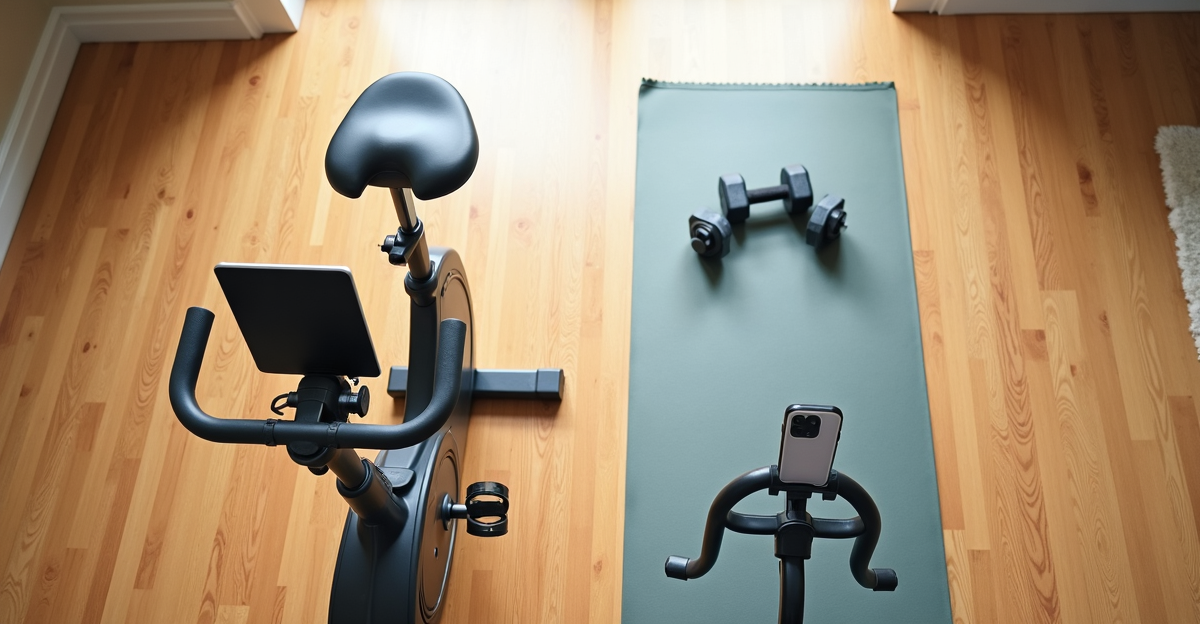
- You have a stationary bike — any stationary bike — and want structured classes to use with it
- You’re okay with ~$13/month for a cardio-first app
Skip both if:
- You’re early in your fitness journey and haven’t figured out what workouts you’ll actually stick to
- Budget is the primary constraint — explore free options first
- You want structured progressive overload programming for serious strength training; neither app is built for that. If you want AI-assisted workout planning, there are AI personal trainer apps that cost less and are built specifically for that use case.
Cost verdict for 2026 home gym people: Apple Fitness+ is the better value for most. Peloton App is good — but “good” doesn’t mean “better for you.” The brand carries years of hardware-era baggage, and the app still feels like it’s priced for a customer who also owns a $2,500 bike. At $12.99/month, you’re paying a premium for instructor energy and cardio depth. That premium is worth it for some people. For most, it isn’t.
From r/pelotoncycle: “I’ve been using the Peloton app on my dumb stationary bike for 8 months. You 100% don’t need the hardware. The classes are legitimately good.” Agreed. But legitimately good and clearly worth the price difference are two separate questions.
FAQ
Is Apple Fitness Plus worth it if you don’t own an Apple Watch?
Yes. You lose the heart rate ring overlay and metrics sync to Apple Health, but every class is accessible Watch-free. At $9.99/month, it’s solid value without a Watch. If you’re already on Apple One, it’s included — the question becomes moot.
Can you use the Peloton App on non-Peloton equipment?
Yes, fully. Works on any phone, tablet, smart TV, or web browser. No hardware required. Follow cycling classes on any stationary bike, running classes on any treadmill, strength classes with dumbbells or bodyweight. The app has nothing to do with the hardware beyond sharing a brand name.
Which is cheaper long-term?
Apple Fitness+ is cheaper: $79.99/year vs ~$155.88/year for Peloton App — roughly $76 cheaper annually. If you’re already paying for Apple One, Fitness+ is included at no additional cost, making the gap even larger.
Is the Peloton App worth paying for after their restructuring?
For a one-year commitment: yes, if you’re cardio-focused. The app is actively maintained in 2026. For longer-term planning, Apple Fitness+ carries less platform risk given Peloton’s recent financial history. That’s not a prediction of collapse — it’s an honest risk assessment.
Does Apple Fitness Plus have enough strength and HIIT for serious home gym training?
For intermediate users: yes. The strength and HIIT library works well with dumbbells and covers most movement patterns. For advanced lifters who want progressive overload with periodization built in, neither Fitness+ nor Peloton App will replace a structured strength program. Both apps are better for workout execution than program design.
The Verdict
Apple Fitness+ is the better value for most home gym people in 2026 — cheaper, broader, backed by a company that isn’t in the middle of a turnaround.
Already in the Apple ecosystem? Start the Fitness+ free trial. Test it Watch-free on your phone or TV for a week before deciding whether you want the Watch integration.
Primary focus is cycling or running, and the Peloton instructor energy genuinely makes you work harder? The Peloton App trial is worth running side-by-side for a week to compare. Some people find the personality-driven classes significantly more motivating, and motivation has a real dollar value in fitness.
Either way: the best workout subscription is the one you’ll actually open. Pick the one whose instructors make you less likely to hit snooze.